Relay Lenses I: NV Imaging Systems
In my last post, I mentioned two different relay lens systems for image intensified astrophotography (I2AP,) specifically the Ofus/Nvisys GEM-II and the Litton 1x SLR relay for the M944A. Relay lenses are specialized optics that take an image (e.g. from a microscope or image intensification tube) and focus it into a sensor, typically inverting the image in the process.1 This is necessary for MX-10160 and MX-11769 tubes as those tubes have a fiber optic inverter, thus the relay needs to re-invert the image for sensor use, and also correct for the distortions in a curved fiber-optic output. For my NV photography, relay lens systems have entirely supplanted afocal imaging with a PVS-14 since I get less optical distortions.
Relay Lens Systems
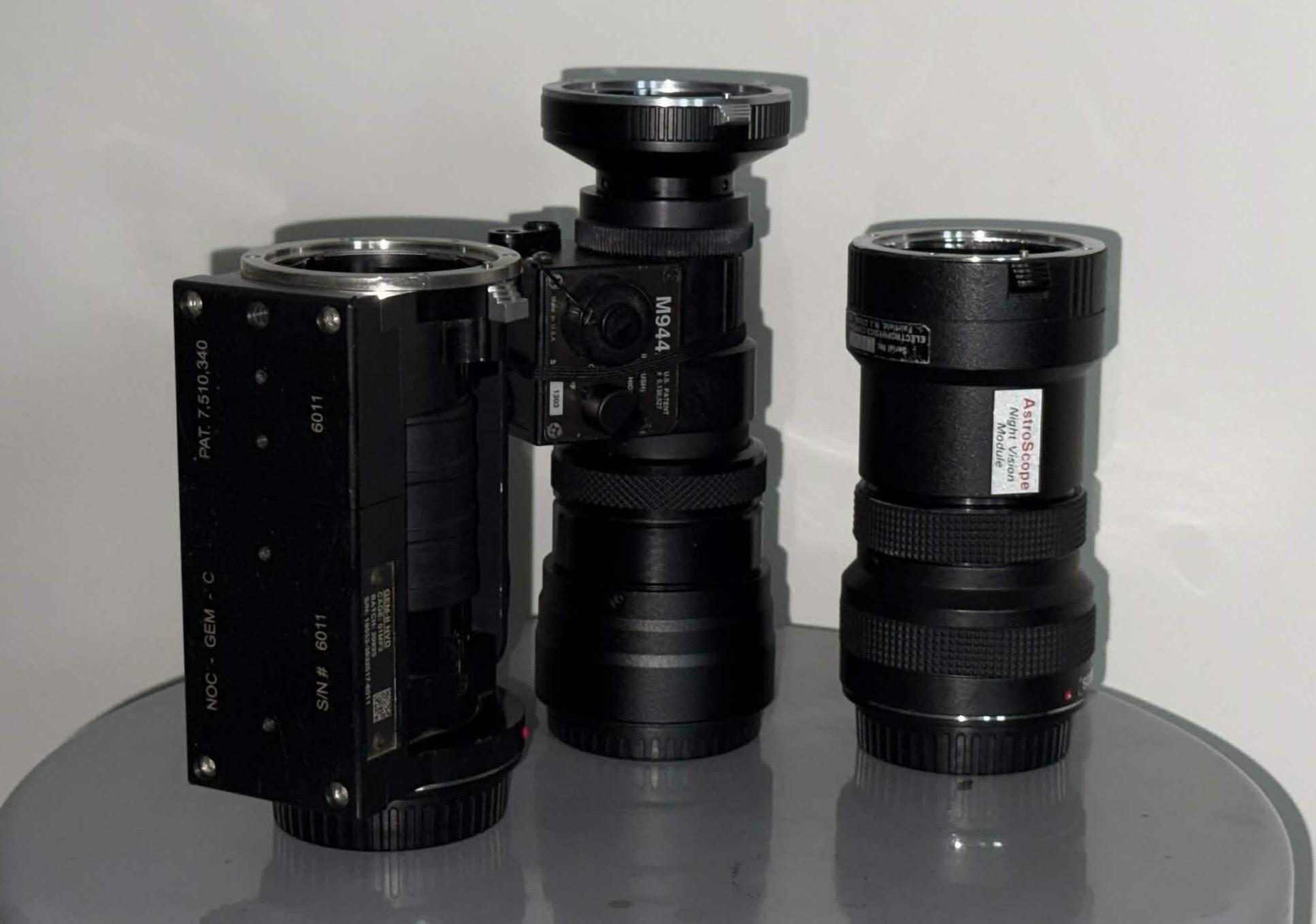
From left to right: GEM-II, M944 and 1x relay, and 9350 Astroscope
There are three relay lens systems I evaluated for this write-up: the Ofus/Nvisys GEM-II, Litton 944A/SLR relay, and the Lynred/Sofradir/Electrophysics 9350 Astroscope. Each relay lens system has its own pros and cons, and all three have unique optical properties and parameters. My setup for this comparison consists of a lens (Canon EF 200mm f/2.8 L II), the relay lens system, an adapter (Canon RF to Canon EF or Canon RF to T2) and then the camera (Canon EOS RP.) The exposure is automatic, and not consistent between shots. Two tubes were used to test the systems: An ITT F9800N thick film tube2,3 and an L3Harris 18UM filmless tube4. Image targets were a USAF-1951 resolution test target5 and a tree out in my yard.
Quick disclaimer: I recieved the Litton 1x from Carlough Manufacturing as compensation for my services. The other two relay lens systems were purchased with my own money.
OFUS/NVISYS GEM-II
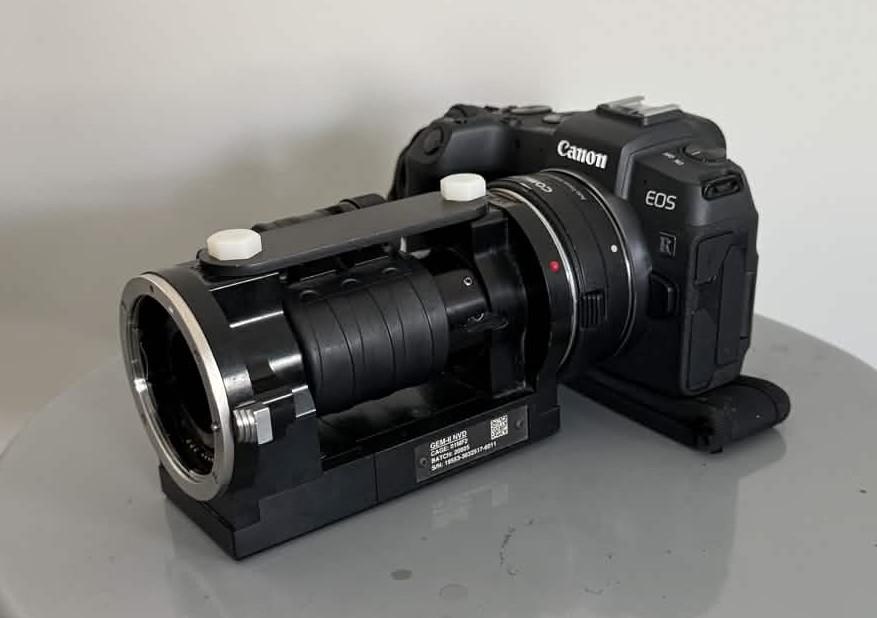 GEM-II relay lens mounted to my camera
The first relay system I got was the Ofus/Nvisys GEM-II. It is a Nvisys MUM-14 adapted to use Canon EF (though Nikon F mount GEM-IIs were made as well) lenses as an objective, with a relay and Canon EF mount to directly connect to compatible cameras. Since I started my astrophotography journey with a Canon 7D mark II, this was a logical first system since I did not need any adapters. The GEM-II also has an interesting feature: full electronic lens control, with contacts going from the camera to the lens, allowing one to use the camera to control the lens settings such as aperture. Unfortunately, autofocus does not work with image tubes.
The GEM-II projects a full-frame image circle, and the relay lens focus is adjusted by pushing or pulling the relay lens unit, and locking it in place with grub screws. Unfortunately, this leads to some problems, namely the focal plane is not parallel with the sensor, showing up as parts of the image not being in focus (seen in some of my astrophotos.6
ITT F9800N Results
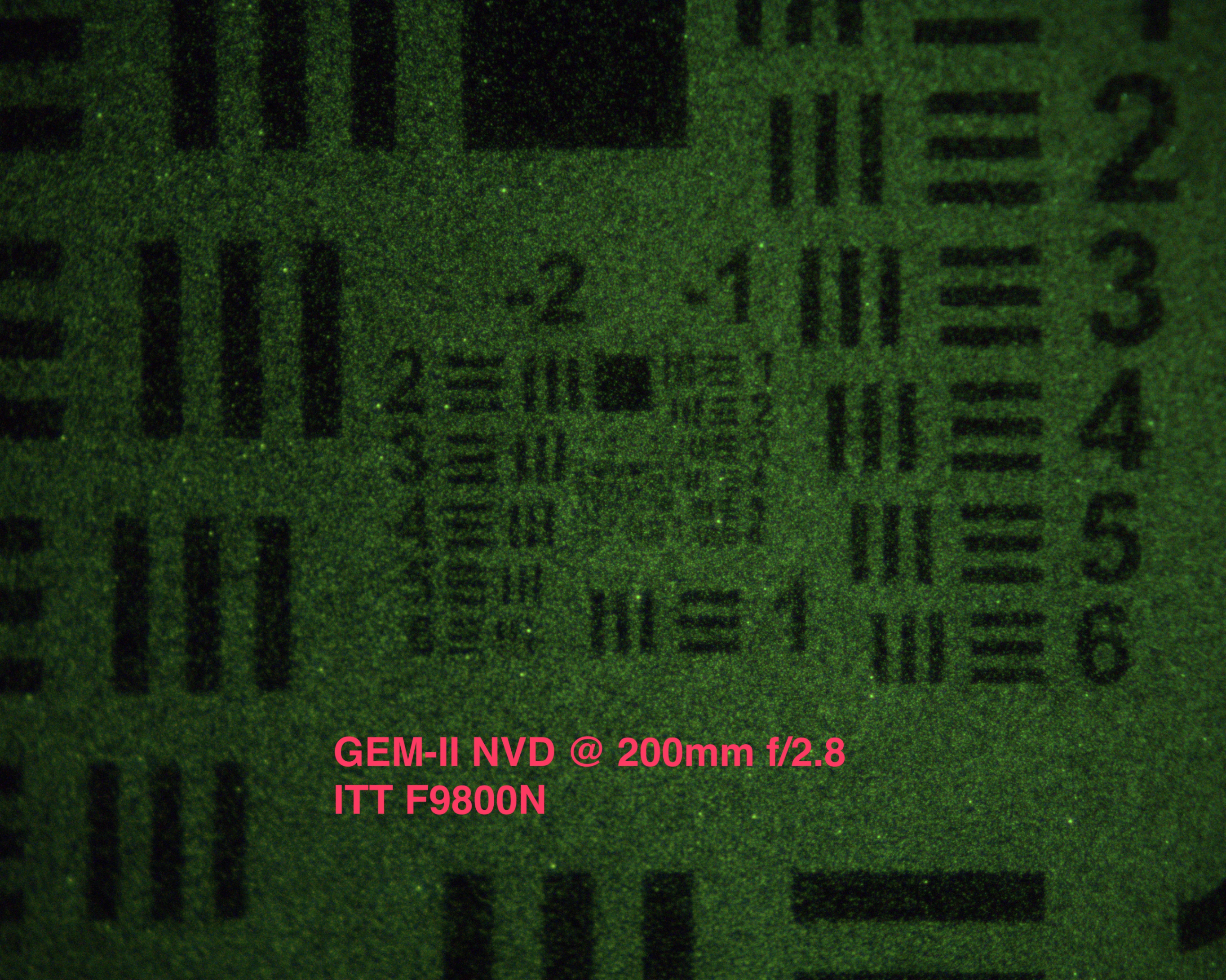 USAF-1951 resolution test target; GEM-II and F9800N
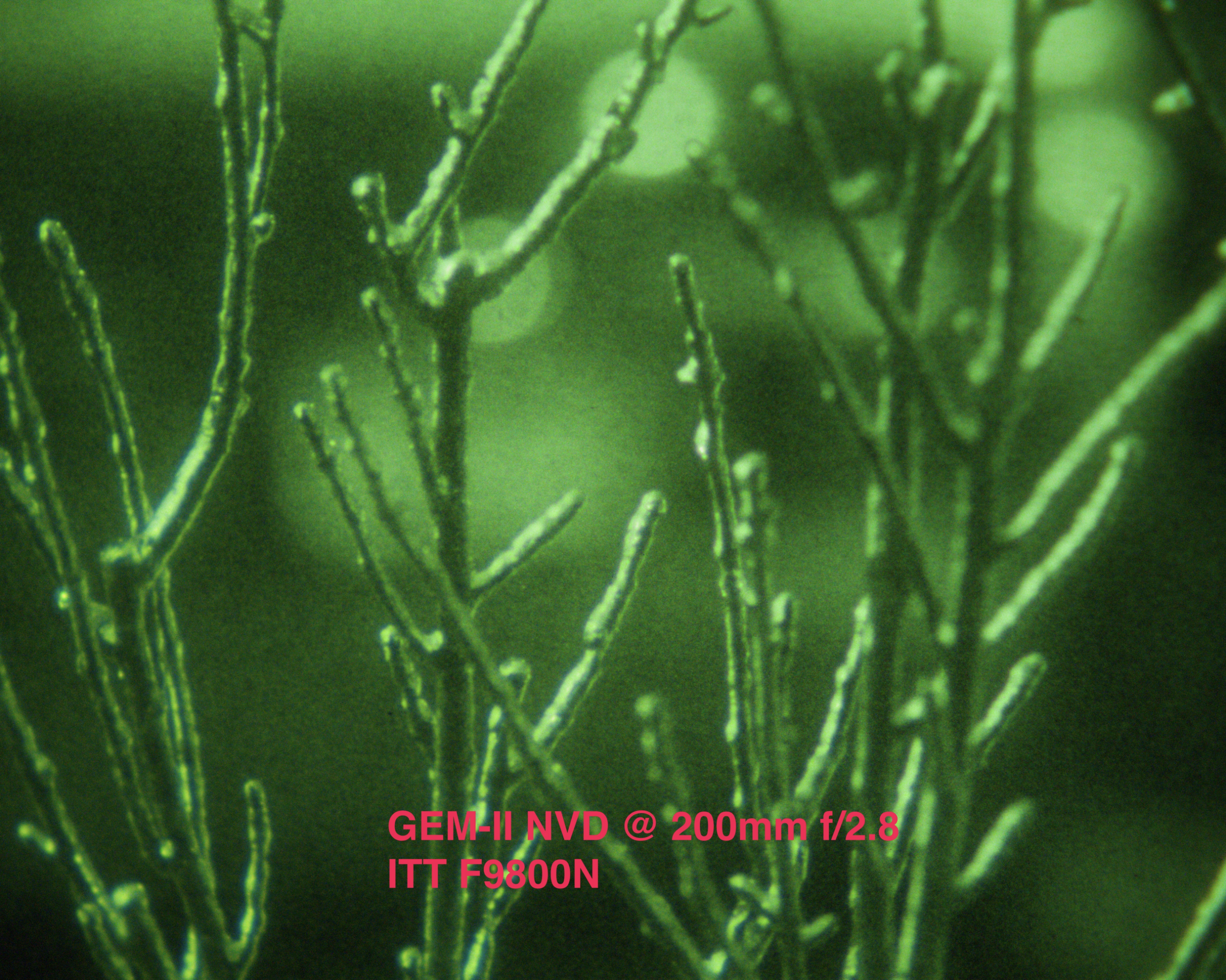 A frozen tree in my yard; GEM-II and F9800N
The GEM-II performs acceptably with the F9800N. The chromatic aberration in the relay lens system is not noticeable with P43 green phosphor tubes. The image is acceptable, but note the edge distortion being worse in the upper right and lower left corners; this is indicative of the non-parallel focal plane.
L3Harris 18UM Results
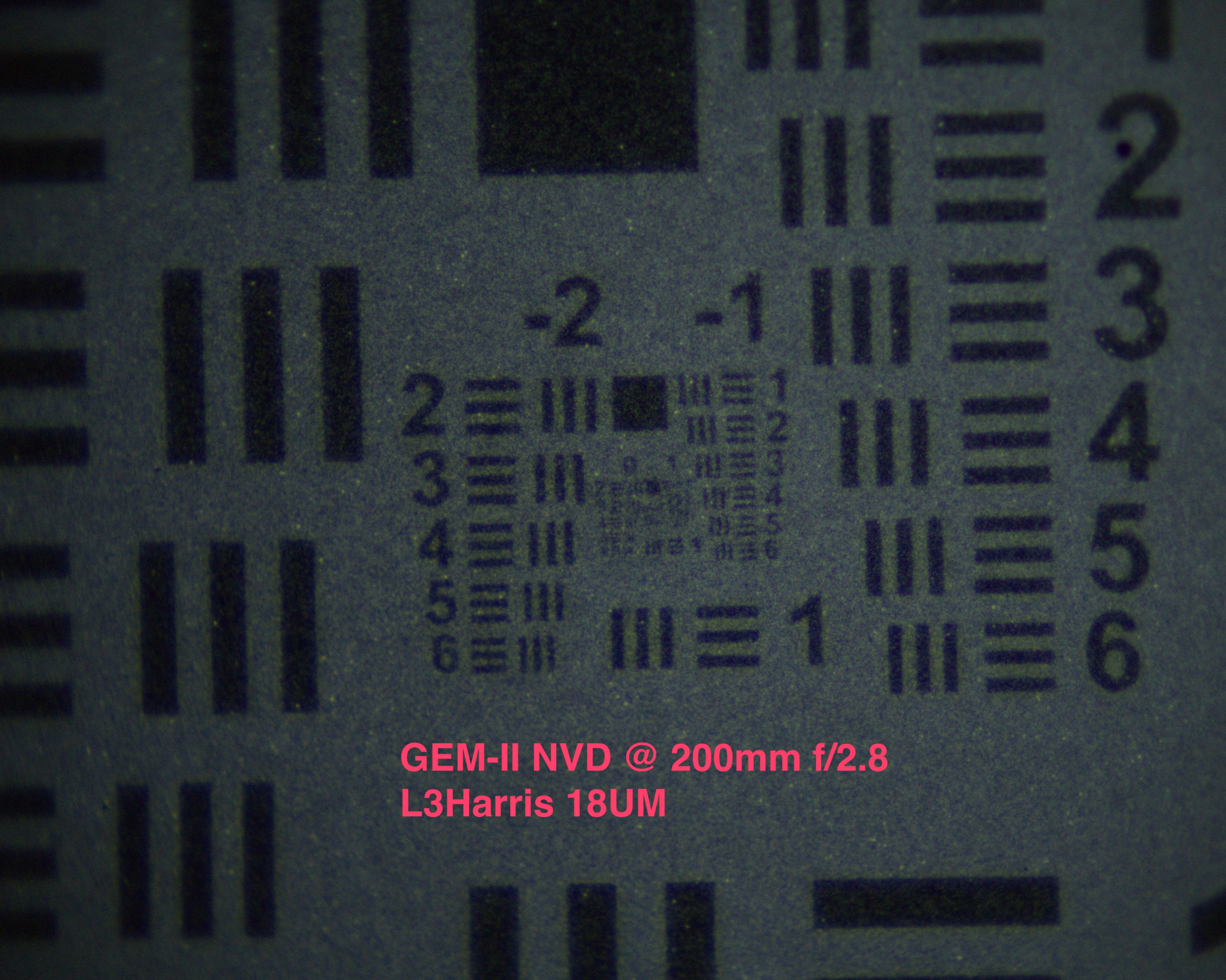 USAF-1951 resolution test target; GEM-II and 18UM
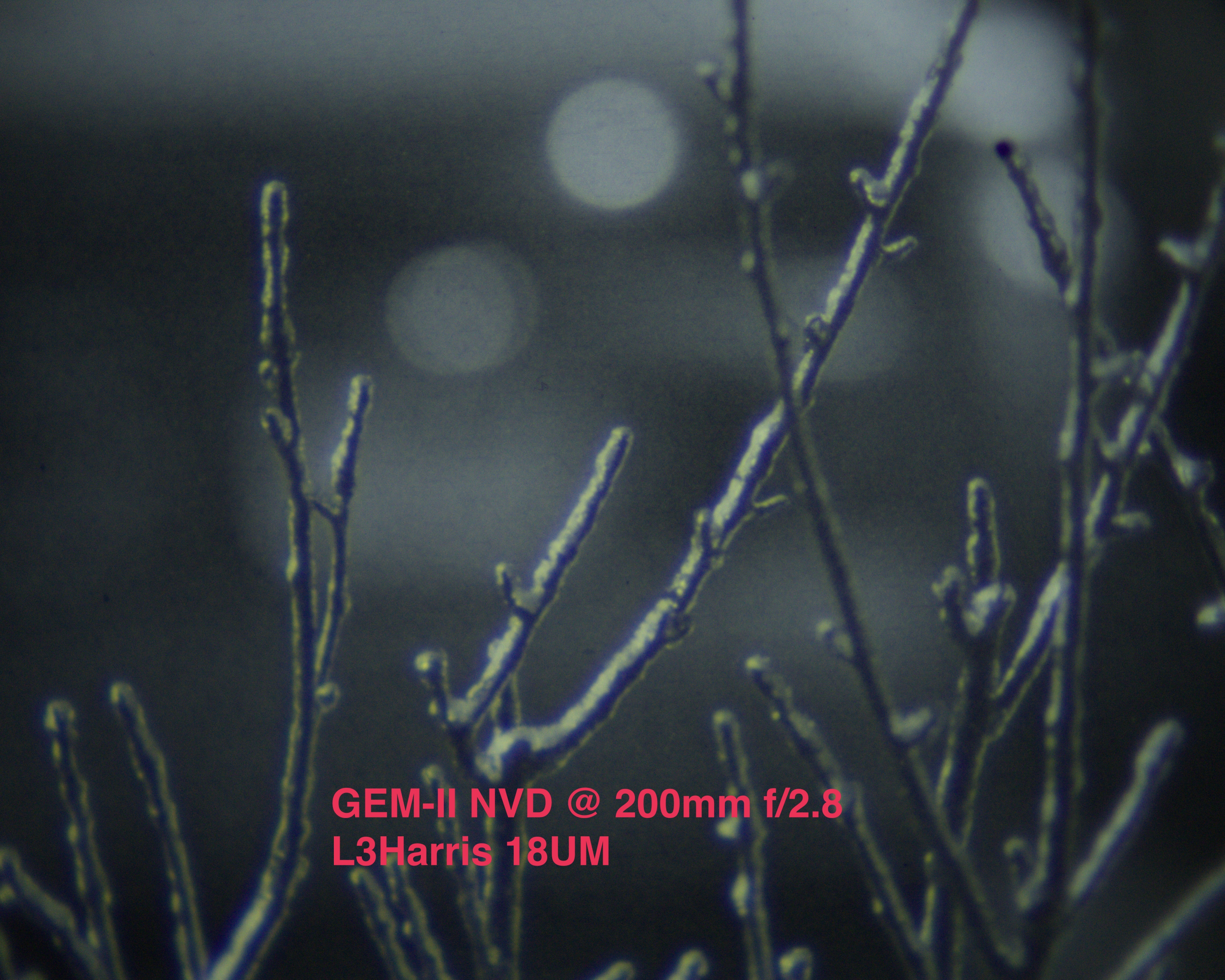 A frozen tree in my yard; GEM-II and 18UM
The problems arise once I swap the F9800N with my white phosphor 18UM. The additional blue emission lines from the white phosphor (P45) do not play well with the singlet optics in the GEM-II, and severe blue/yellow fringing is visible in the shot of the tree. Blue/yellow fringing is somewhat visible in the resolution test target, though to a much lesser extent. This was ultimately the deal-breaker with the GEM-II as the chromatic aberration would set a hard limit on the sharpness on the image.
Litton C-Mount M944A & Litton 1x SLR Relay
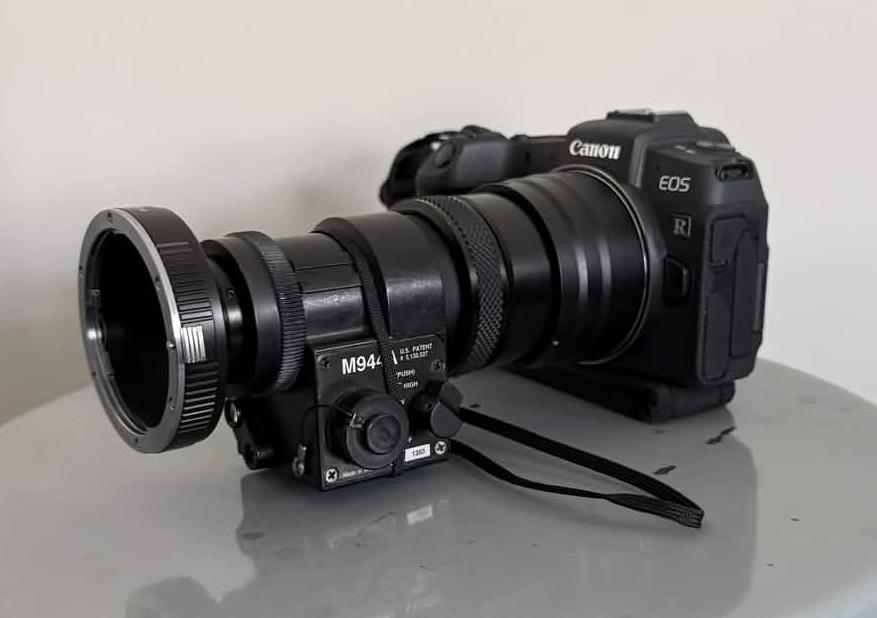
To replace the GEM-II I would purchase a C-mount Litton M944A, and acquire a Litton 1x SLR relay. The M944A is what I call the "PVS-18 we have at home" due to the optics being interchangable with PVS-15 and PVS-18 optics. At the time I had sold my first PVS-14 leaving me with only one NVD, so I decided to make the jump to a do-it-all NVD that could be head mounted (with a custom J-arm) and also be used for photography; I would start working for Carlough Manufacturing around this time and pick up the Litton 1x SLR relay lens. Although the Litton relay lens was designed with pocketscopes in mind, it has the same threading as the PVS-5, PVS-15, and PVS-18 so in theory it could be used on those NVGs. From what I've gathered, the Litton 1x relays were OEMd by Fujinon, though I do not have a hard citation on that claim.7 I used an EF to C-mount adapter to attach the 200mm lens to the M944A. Although I do not have electronic lens control, for I2AP I never stop down the lens at all, so the lack of lens control doesn't impact my work. For NV photography, I just use manual lenses.
The Litton 1x SLR relay projects an 18mm image circle, originally intended for use with 1" camera sensors or 35mm film. The image circle is rather small for what it is, which caused a lot of problems with siril refusing to stack images and throwing multiple errors every time. However, out of all the relay lenses I've tested so far, the Litton 1x has by far the flattest and cleanest image I have seen. The optical design appears to have at least one achromatic doublet which shows up as better chromatic aberration suppression and more worryingly, delamination in the rear element. My unit's delamination is quite mild, although I have seen quite nasty delamination from these old relay lenses.7
ITT F9800N Results
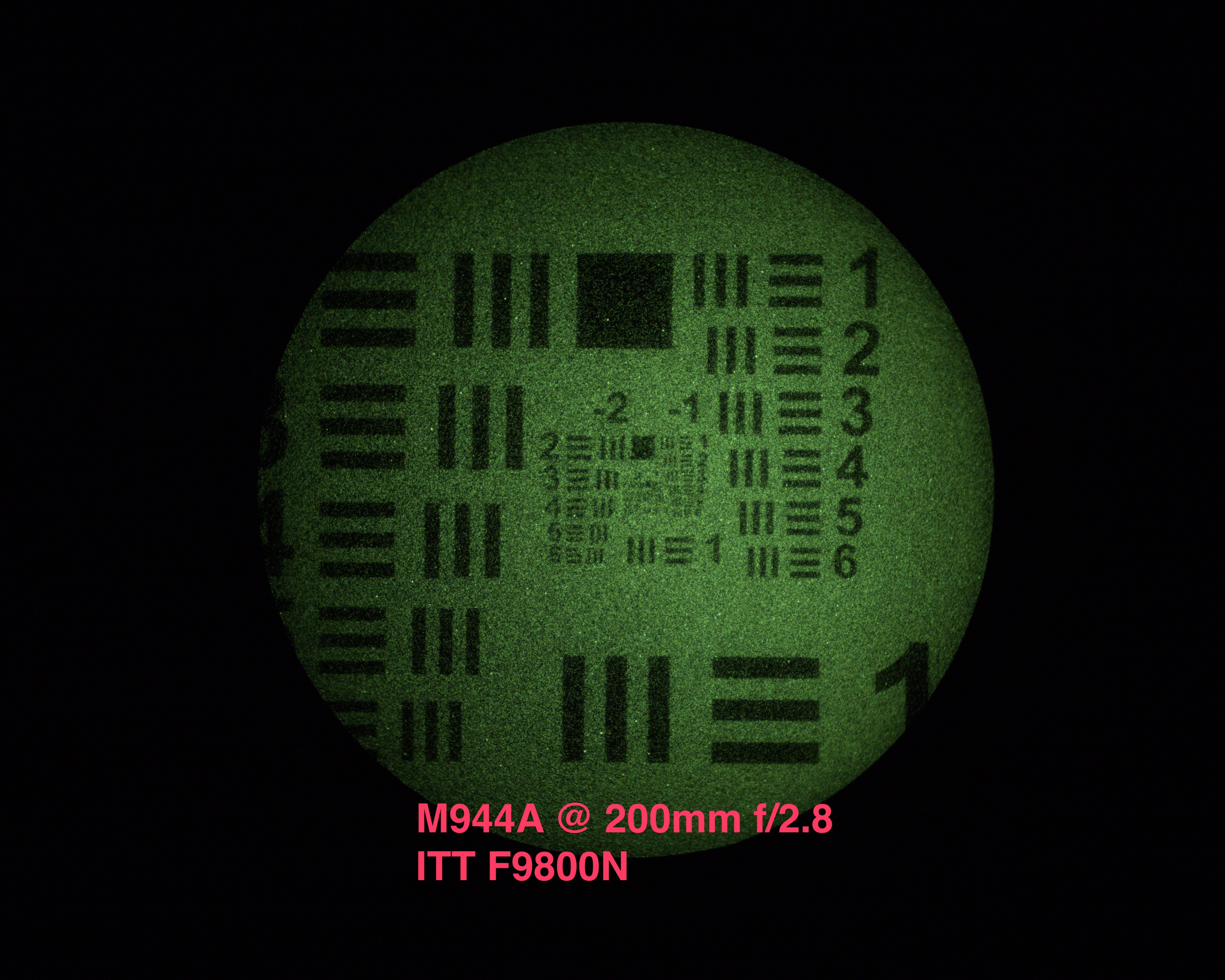 USAF-1951 resolution test target; M944A/Litton 1x and F9800N
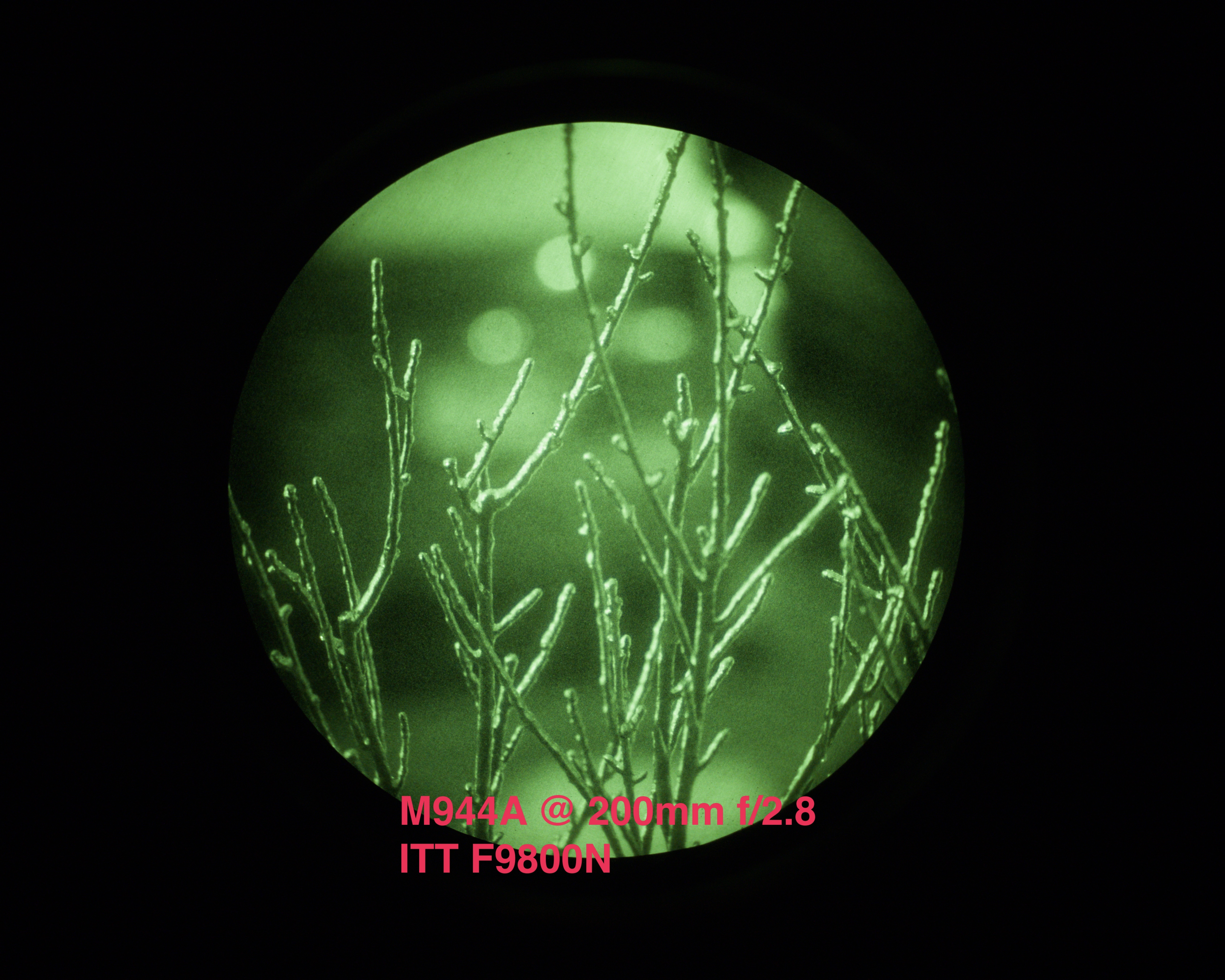
A frozen tree in my yard; M944A/Litton 1x and F9800N
The Litton 1x performs admirably with the F9800N, although the image size limit on BearBlog as well as file compression from shuffling images between multiple devices means any quantitative measure of resolution with the USAF-1951 resolution test target would not be demonstrable. Note the flat image, and how the image circle is fully visible in the image frame.
L3Harris 18UM Results
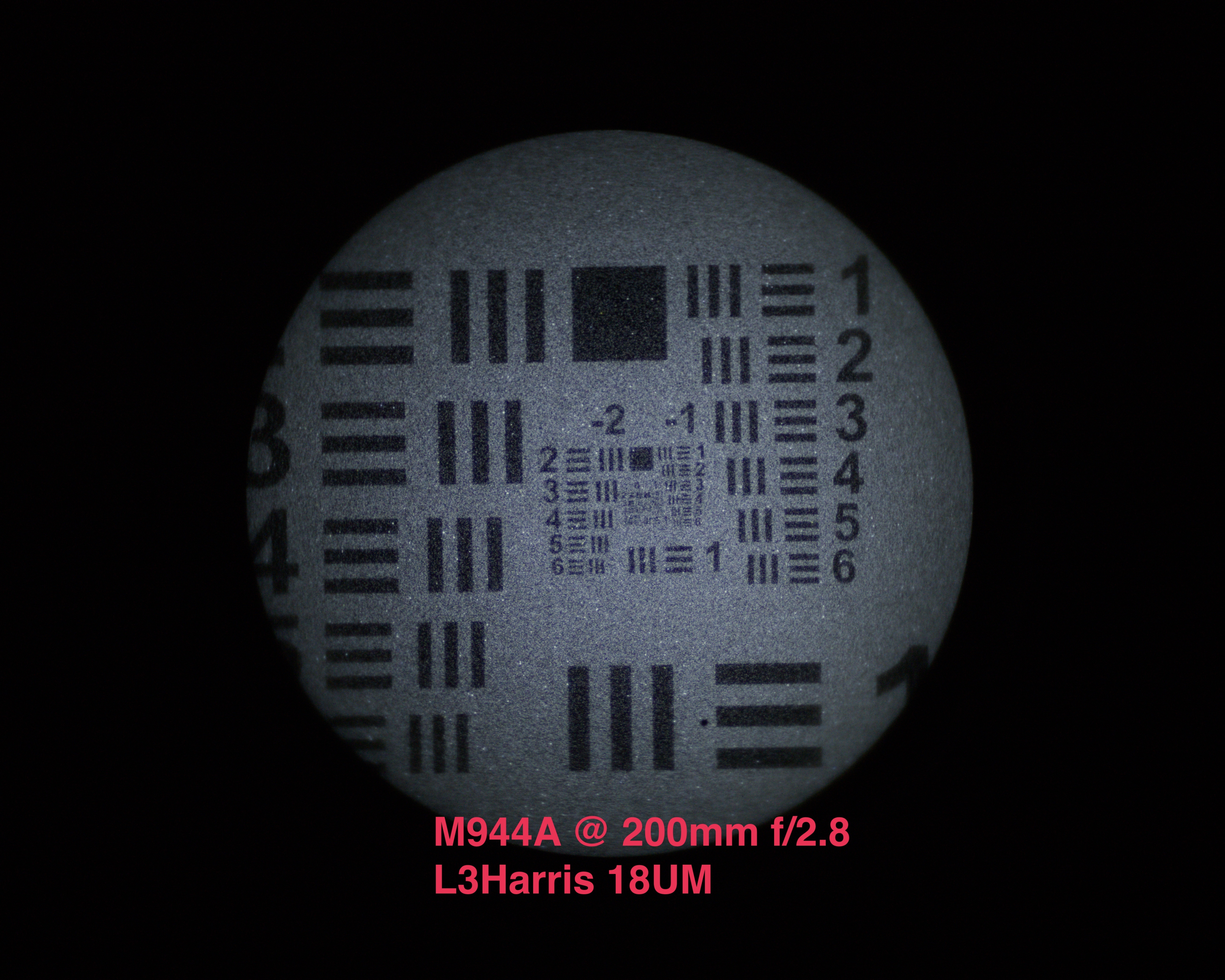 USAF-1951 resolution test target; M944A/Litton 1x and 18UM
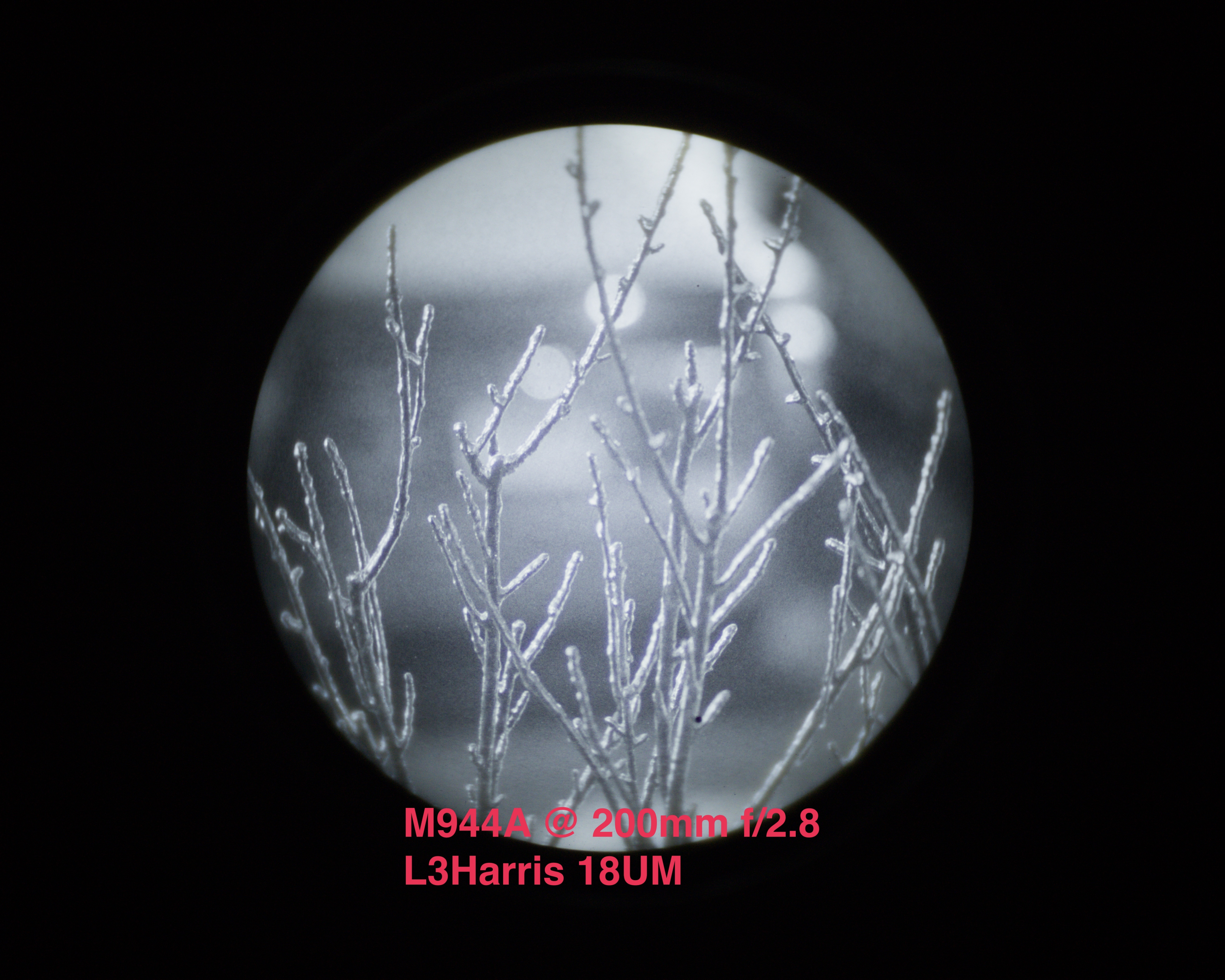 A frozen tree in my yard; M944A/Litton 1x and 18UM
Switching to my 18UM white phosphor tube, the difference in chromatic aberration is substantial when compared to the GEM-II. It's hard to spot in the USAF-1951 resolution test target, but on the tree it appears as blue traces around the iced-up branches. The image flatness is most visible here, with distortion only visible in the "zone 3" equivalent in IIT evaluation. Most of my astrophotos taken after November 2025 are shot with this imaging system, albeit with a green filter for maximum sharpness.
ElectroPhysics/Sofradir/LYNRED 9350 Astroscope
The last relay lens system I evaluated was the 9350 Astroscope. My astroscope was an old ElectroPhysics mode, but they have been sold under Sofradir and Lynred as well. The EOS front lens assembly (FLA) and back body assembly (BBA) are especially hard to find, so this unit was particularly worth it to me. I ended up snagging this model from a Japanese seller on EBay for an excellent price, and it came with the F9800N IIT that I used in this evaluation. Like the GEM-II, the 9350 Astroscope has electronic lens control but unlike the GEM-II it does not have a battery; the power for the image tube comes from the camera itself. Compared to the GEM-II, the astroscope is lighter and a bit more compact. The astroscope has a strange quirk, if for whatever reason the camera is not in photography mode (e.g. settings, photo viewing,) the tube is not powered. This makes sense, though that does mean that if a manual lens is installed the astroscope will not turn on.
The 9350 Astroscope appears to be designed around APS-C sensors (the OEM sold a reducer to adapt it to full-frame) so when shot on my full frame camera, there is still a visible image circle, however it sits in between the GEM-II and the Litton 1x as far as image circle size goes. Optically, the Astroscope sits somewhere in between the atrocious optics of the GEM-II and the excellent optics of the Litton 1x. The edge distortion extends further than the Litton 1x, though at least the focal plane is parallel with the sensor.
ITT F9800N Results
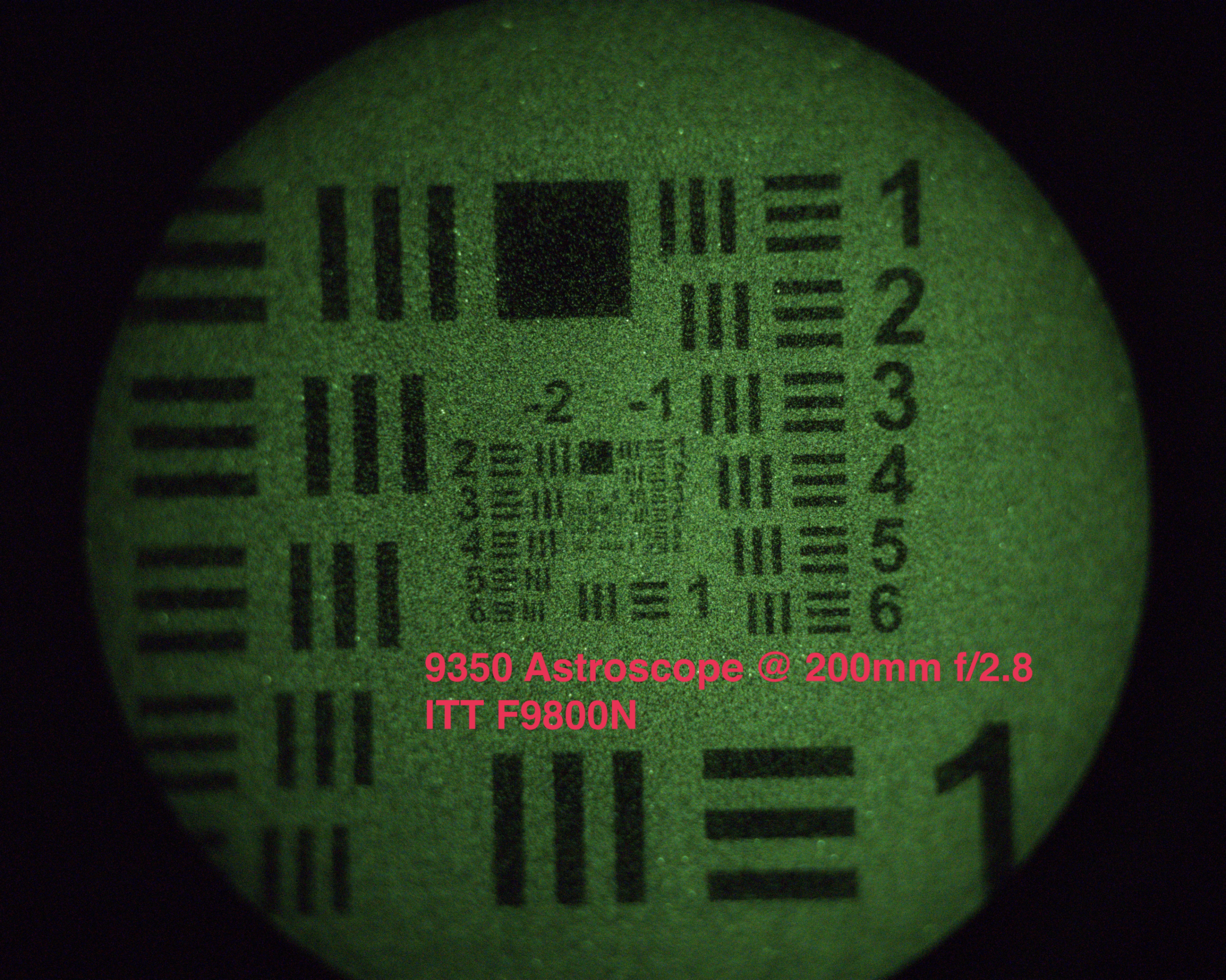 USAF-1951 resolution test target; 9350 Astroscope and F9800N
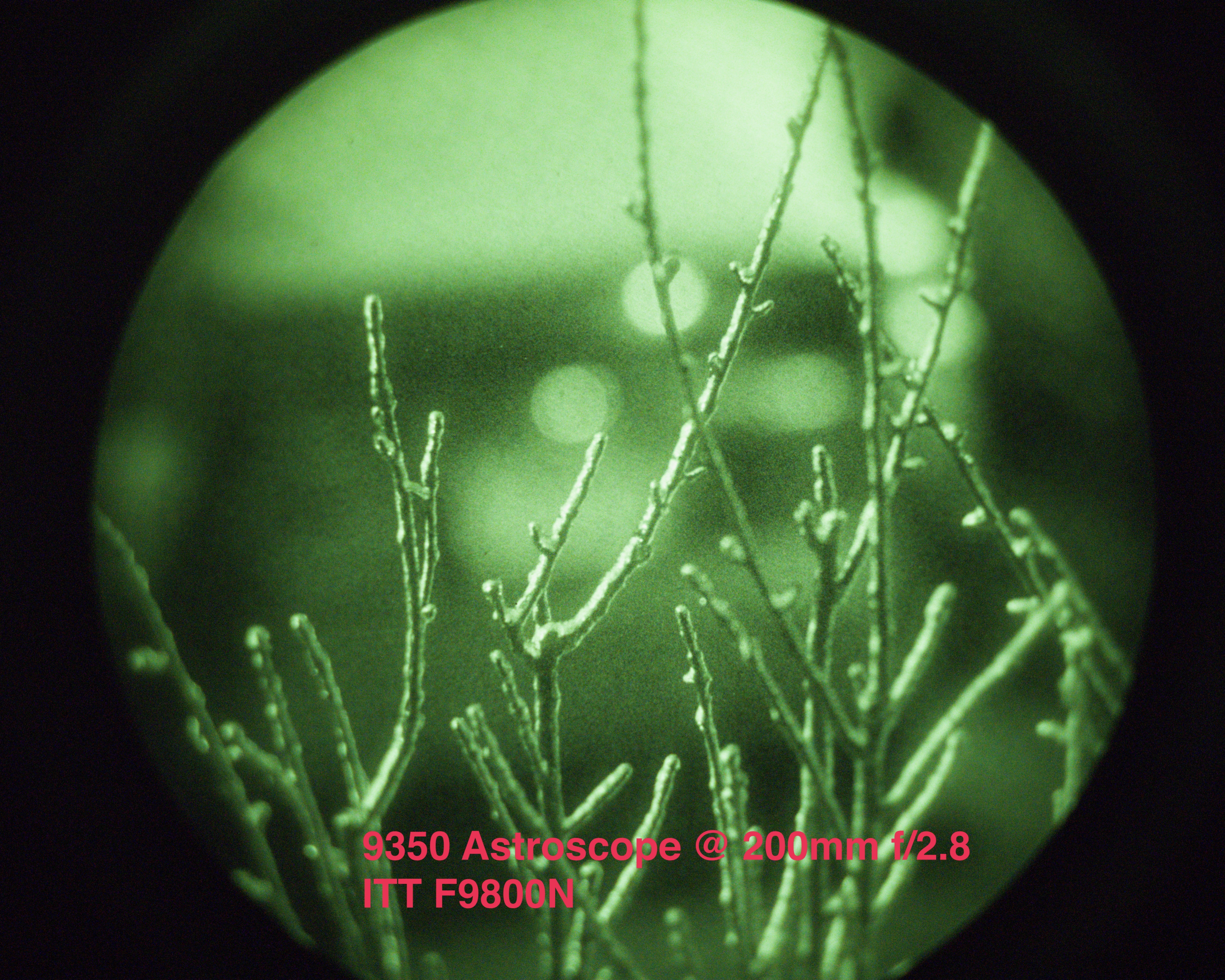 A frozen tree in my yard; 9350 Astroscope and F9800N
As expected, the F9800N performs quite well. The only notable drawback of the astroscope is the edge distortion, though when shooting on APS-C, this would not be as big of a problem as it is on full frame. Note the edge blur in both the USAF-1951 resolution test target and the frozen tree.
L3Harris 18UM Results
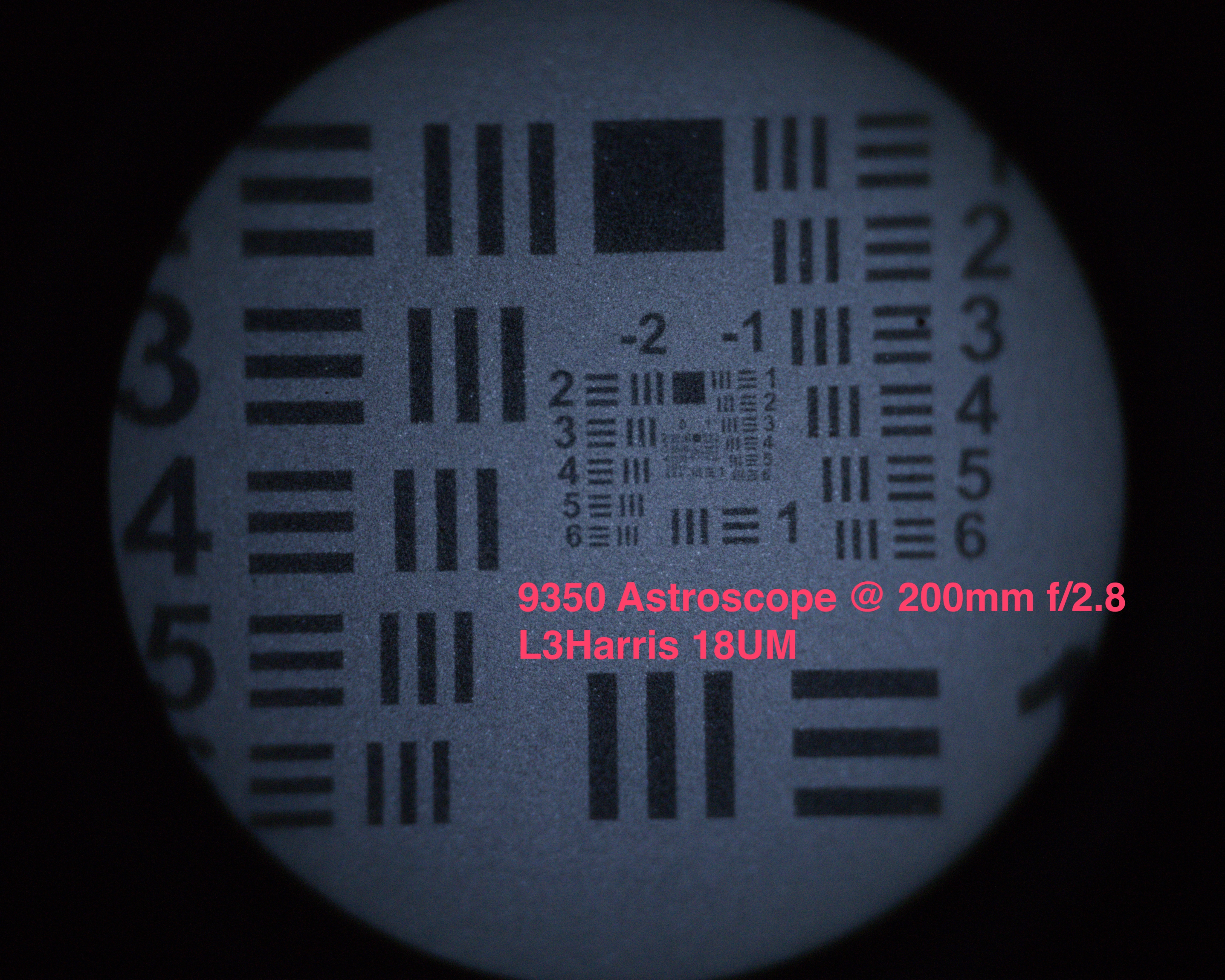 USAF-1951 resolution test target; 9350 Astroscope and 18UM
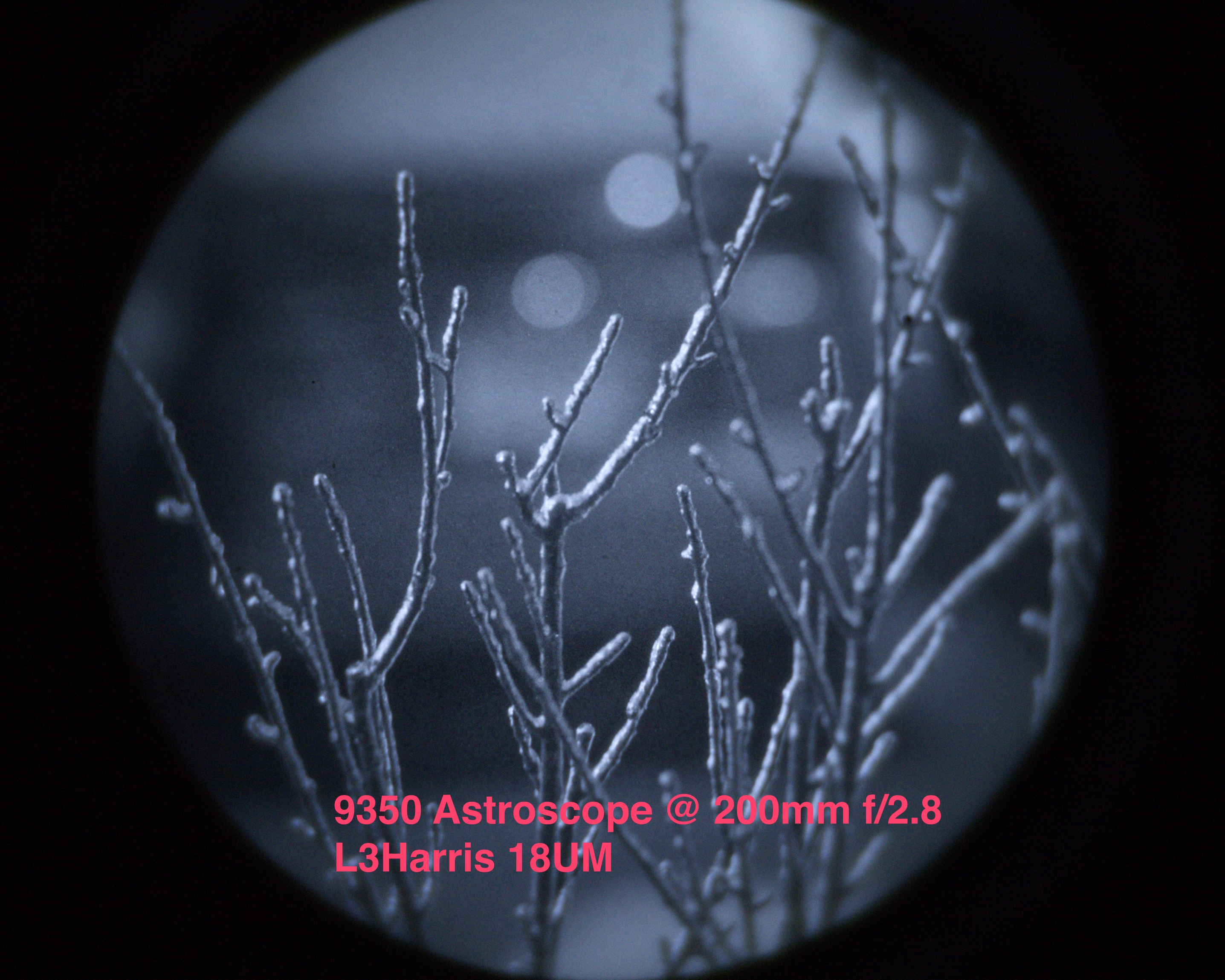 A frozen tree in my yard; 9350 Astroscope and 18UM
One of the reasons I picked up the 9350 astroscope was an unfounded rumor that the astroscope had outstandingly good chromatic aberration control (why else would they cost over $8000?! 8) My baseless assertion was correct though, and the 9350 Astroscope is by far the best when it comes to chromatic aberration control. There is no blue/yellow fringing visible in the USAF-1951 resolution test target, nor are there blue traces on the iced-up tree. This imaging system does not need a filter to remove chromatic aberrations, though the edge distortion does leave something to be desired.
Discussion and Conclusions
Comparing the three NV imaging systems and deciding which unit to keep was not particularly difficult. The GEM-II was going to go anyway, being entirely surpassed in optical quality by the M944A. Keeping the astroscope on the other hand was a harder decision. On one hand, the chromatic aberration control was outstanding, and the optical quality was on par with the Litton relay, albeit with the downside of edge distortion. On the other hand, the astroscope could not be head mounted (still a consideration at the time,) shut off a little too often for my liking, and most glaringly, could not be used with either telescopes or manual lenses as the unit would not power on otherwise. Due to those limitations, I chose to sell both my GEM-II and 9350 Astroscope.
In a vacuum, if I were to start again with my 7D Mark II, I probably would've kept the Astroscope for far longer if I bought it first. A lot of my initial GEM-II problems stemmed from resolution loss due to shooting on crop-sensor, which led me to getting my EOS RP and later the M944A. However, I do believe that lens-mount systems would be a dead-end for me, as no matter how good the relay lenses are, not being able to mount the imaging system to a telescope would hinder me in the long run. It could be argued that since I got the M944A at a bargain bin price and the Litton 1x relay for free that I would be biased to favor them, and to some extent it's true. Looking back now 4 months after evaluating the imaging systems, I'm hard pressed to choose anything over the M944A and Litton 1x. I am aware of other relay lens systems; ITT made a 1x relay lens for their NightQuest 6010 pocketscopes, and Litton made a 0.66x relay lens designed for 2/3" CCD sensors. Having picked up an ITT 1x relay recently, the next post will be evaluating it head-to-head against the Litton 1x, as well as examining other variables such as the filter I use with white phosphor tubes or teleconverters to get a larger image circle.
In conclusion, the GEM-II, M944A w/ relay, and the 9350 Astroscope all bring a unique and seldom-seen capability to NV photography. While for the majority of NV users, a cellphone camera carefully positioned behind the ocular can deliver sufficiently good results, the relay lens offers capability such as long-exposure photography as well the flattest possible image (besides direct-mount CCD or EBAPS) that to the right end user, may be useful. However, each NV imaging system has downsides as well; with the GEM-II and 9350 Astroscope being exclusively camera mounted, and the Litton M944 + relay combo being incredibly dated by today's standards. In an ideal world, there would be a relay lens that projected an image as flat as the M944A at the APS-C scale of the 9350 Astroscope, with the optics train designed around white phosphor image tubes, all while being able to screw onto PVS-14/ANVIS ocular threads as a drop-in option on say, an RVM-14C. Until then, it is my opinion that the litany of old pocketscopes and relays are the best option to capture the highest quality NV photos. Furthermore, those pocketscopes and relays tend to be in low demand, so they're quite affordable. At the time of writing, one can purchase a 1x relay lens (ITT or Litton) and M944 pocketscope (with glass) for less than the cost of a used PVS-14 housing.
Next Up: A direct head-to-head comparison of the Litton 1x and the ITT 1x relay lens, as well as filters for chromatic aberration, and using teleconverters for relay lens NV photography.